
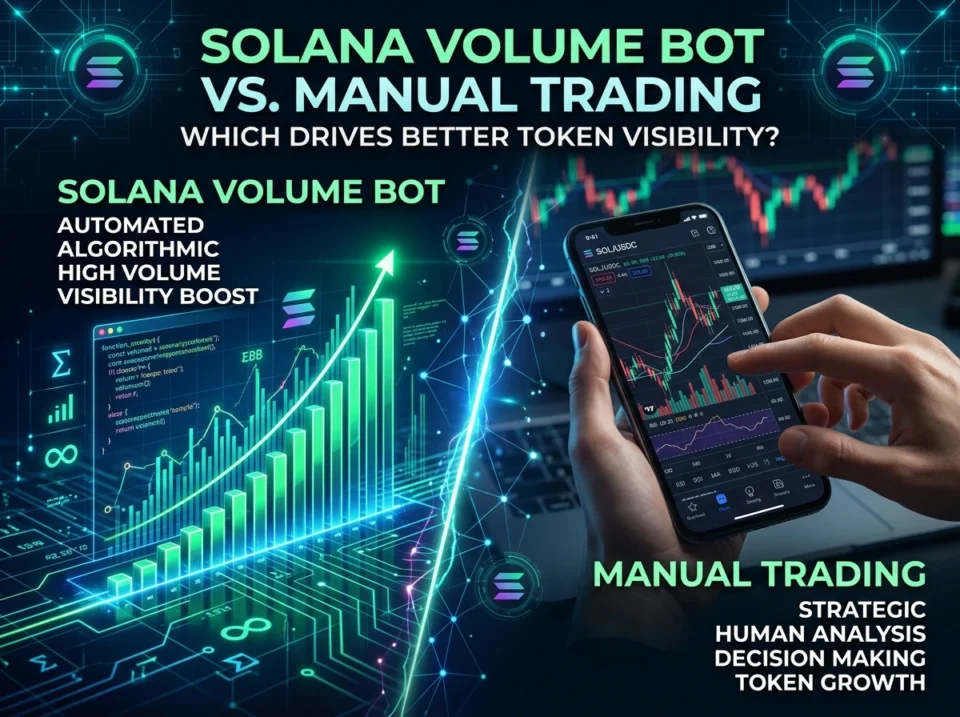
Getting a token noticed on Solana is no small task. With thousands of projects launching across decentralized exchanges and aggregators, standing out takes more than a great idea. It takes visible market activity. Volume is one of the first things traders, analysts, and screening tools look at when deciding whether a token deserves attention.
That raises a practical question for many project teams: should you generate market activity manually, or rely on automated tools built for the job? Both approaches have their place. This article breaks down how they compare across the factors that matter most—visibility, efficiency, scalability, consistency, perception, and risk—so you can make an informed decision.
Why Token Visibility Depends on Volume
Before comparing methods, it helps to understand why volume matters so much on Solana.
Most token discovery happens through platforms like DEX screeners, trending pages, and analytics dashboards. These tools rank and surface tokens based on activity signals, and trading volume is a primary one. A token with steady, healthy volume looks active and credible. A token with flat charts and no movement often gets overlooked, regardless of its fundamentals.
Volume also affects how new buyers perceive a project. People tend to trust what others are already engaging with. Visible activity creates a sense of momentum, which can encourage organic participation. In short, visibility and volume feed each other, and that loop starts with market activity.
The Manual Trading Approach
Manual trading means a person, or a small team, executes trades by hand to create movement and presence in the market. This is the traditional method many early projects start with.
Strengths of Manual Trading
Full control and judgment. A human trader can react to market conditions, adjust timing, and make decisions based on context that software might miss. If sentiment shifts or news breaks, a manual trader can respond immediately with nuance.
Lower technical barrier. You do not need to configure software or understand automation logic. Anyone with a wallet and some capital can begin trading.
Authentic feel. Because a real person is making choices, trading patterns can feel natural and varied, which some teams prefer for credibility.
Limitations of Manual Trading
The drawbacks become clear quickly. Manual trading is slow and demanding. To maintain consistent activity around the clock, you would need people working in shifts, which is expensive and exhausting.
Consistency also suffers. Humans get tired, distracted, and emotional. Maintaining steady volume for days or weeks by hand is nearly impossible without errors or gaps. And those gaps are exactly when visibility drops.
Scaling is another problem. Generating meaningful volume across multiple pairs or sustaining activity during high-traffic periods requires far more capacity than a small team can realistically provide.
The Volume Bot Approach
Automated tools take a different route. A Solana volume bot executes trades programmatically based on settings you define, handling activity that would otherwise demand constant human effort. Tools like the solana volume bot are designed specifically to streamline this process on the Solana network.
Strengths of Volume Bots
Speed and efficiency. Bots execute trades in seconds and can run continuously without breaks. They process transactions far faster than any person, which matters on a fast network like Solana with low fees and high throughput.
Scalability. A bot can manage activity across multiple pairs and sustain volume during long campaigns without adding staff. As your needs grow, you adjust the configuration rather than hiring more people.
Consistency. Automation does not get tired or emotional. It follows your parameters reliably, which helps maintain steady activity signals over time. For visibility on screeners that reward consistent volume, this is a clear advantage.
Time savings. Your team can focus on building, marketing, and community while the bot handles routine market activity in the background.
Limitations of Volume Bots
Bots are not a complete solution on their own. They follow rules, so poor configuration can produce unnatural patterns that look mechanical. Setting them up well requires some understanding of how to mimic realistic behavior.
There is also a dependence on the tool itself. You need a reliable provider, secure setup, and ongoing attention to make sure everything runs as intended. And like any market activity, results depend on broader conditions you cannot fully control.
Head-to-Head Comparison
Let’s look at how the two stack up across the factors that influence token visibility.
Market activity signals. Bots win on raw output. They generate steady, measurable volume that screening tools pick up. Manual trading can create activity too, but rarely at the same scale or consistency.
Efficiency. Automation is far more efficient. What takes a team hours, a bot handles in moments, freeing resources for other priorities.
Scalability. Bots scale effortlessly. Manual trading hits a ceiling fast because it depends on human capacity.
Consistency. Bots maintain reliable patterns over long stretches. Humans struggle to match that without burnout or mistakes.
Trader perception. This is more balanced. Well-configured bots can produce natural-looking activity, but careless setup may appear artificial. Manual trading can feel organic, yet its inconsistency can also raise questions when activity suddenly stops.
Risk considerations. Both carry risk. Manual trading risks human error and high costs. Bots risk misconfiguration and over-reliance on automation. In every case, market activity tactics should support, not replace, genuine value and sound project fundamentals.
Finding the Right Balance
The honest answer is that this is not strictly an either-or decision. Many successful teams use a blended approach.
Automation handles the heavy lifting—the consistent, around-the-clock activity that keeps a token visible on screeners and discovery tools. Manual oversight adds judgment, monitors performance, and adjusts strategy as conditions change. Together, they cover each other’s weaknesses.
For smaller projects with limited budgets and short-term goals, manual trading might be enough to get started. But as a project grows and visibility becomes a sustained priority, automation usually becomes the more practical and cost-effective choice.
Whatever you choose, remember that visibility tactics work best alongside real substance. Volume can open the door and attract attention, but retaining that attention depends on a strong product, active community, and clear communication. Activity signals get people to look; fundamentals get them to stay.
Conclusion
When it comes to driving token visibility on Solana, volume bots hold a clear edge in efficiency, scalability, and consistency. They deliver the steady market activity that discovery tools reward, without draining your team’s time and energy. Manual trading still offers control and a human touch, but it simply cannot match automation at scale.
The smartest strategy combines both: let automation provide the reliable foundation while human judgment guides the bigger picture. Pair that with genuine project value, and you create the kind of visible, credible momentum that helps a token rise above the noise.
If long-term visibility is your goal, automation deserves a serious place in your toolkit—used thoughtfully, and always in service of building something real.
